Our artwork, in the gallery
Hung, framed, in the exhibition.
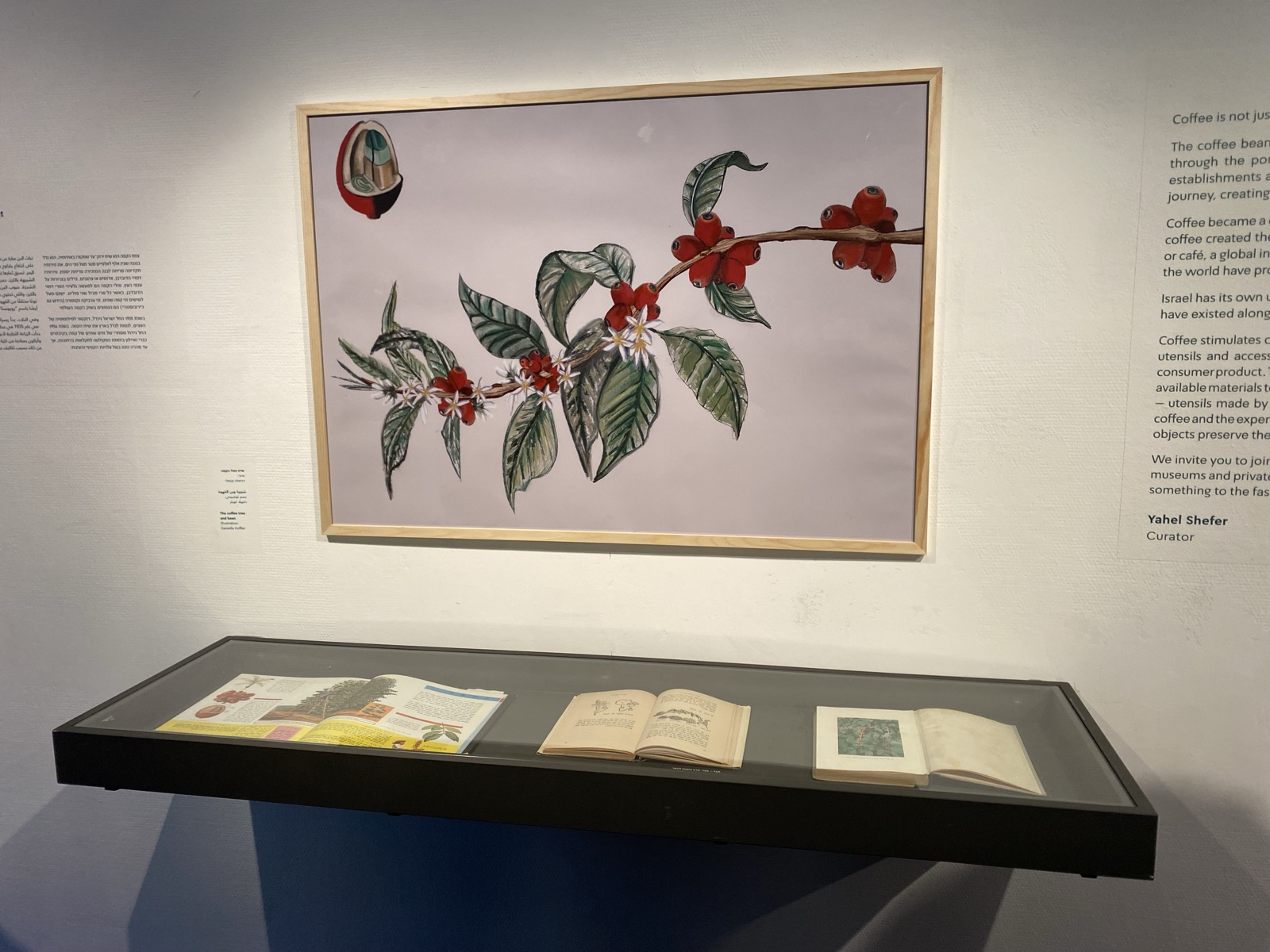
The coffee branch we painted for the show, on the gallery wall above a vitrine of period volumes — Coffea arabica, the plant every object in the exhibition descends from.
A two-and-a-half-minute film that carries coffee from an Ethiopian hillside to a table in a contemporary Israeli café — made to open the museum’s exhibition, and shown at its entrance.
In July 2021 the L. A. Mayer Museum for Islamic Art in Jerusalem opened Coffee East and West, giving three of its main galleries over to a single subject. The exhibition, curated by Yahel Shefer, gathered coffee-making equipment from more than thirty countries — much of it on loan from Turkish collections, since the Ottoman Empire sat at the centre of the coffee trade — and set the tiny handleless cups of Turkish coffee beside the larger china of the French elite. It ran until May 2022.
The argument of the exhibition is in its title. Coffee moves. It travels from Ethiopia and Yemen into the Ottoman world, then into Europe, and arrives in this country twice over: through Arab coffee culture, and again through the German Templers and European Jews who opened Viennese-style cafés in nineteenth-century Jerusalem. Our film had to carry that journey, at the entrance, before a visitor had seen a single object.
The film opens on the mark a cup leaves behind. The title turns inside it in Hebrew, Arabic and English — the exhibition’s three publics, in the trace the object leaves rather than in the object itself. That ring becomes the film’s recurring frame: it opens into landscapes, closes over scenes, and returns at the end to carry the credits.
The coffee branch we painted for the show, on the gallery wall above a vitrine of period volumes — Coffea arabica, the plant every object in the exhibition descends from.
In the film the branch grows into the stain, stroke by stroke. The framed piece on the wall and the opening of the film are one image in two states.
The Ethiopian legend of the herder whose goats would not sleep. The film gives it four seconds and no explanation — the ring opens onto a hillside, the goat is there, and the history begins.
Before the trade, before the cups in the vitrines, someone roasted beans on a hillside. The film spends its opening on that rather than on Europe, because that is the order the exhibition argues for.
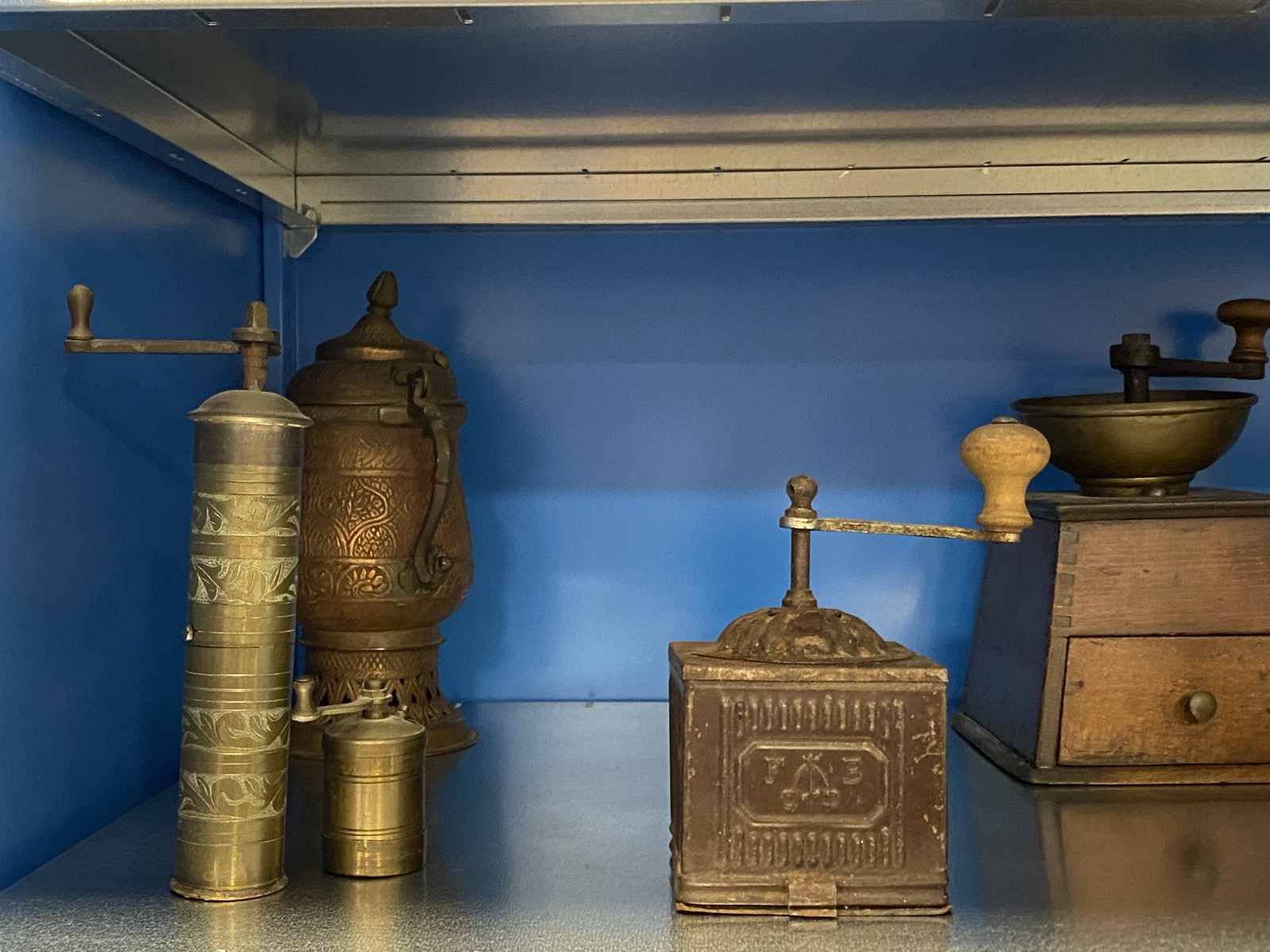
Brass cylinder mills, an engraved box grinder, a wooden drawer — part of the equipment gathered from more than thirty countries.
The film returns the objects to the gestures a vitrine can only imply: the roaster held over coals, the grinder turned, the pot set down.
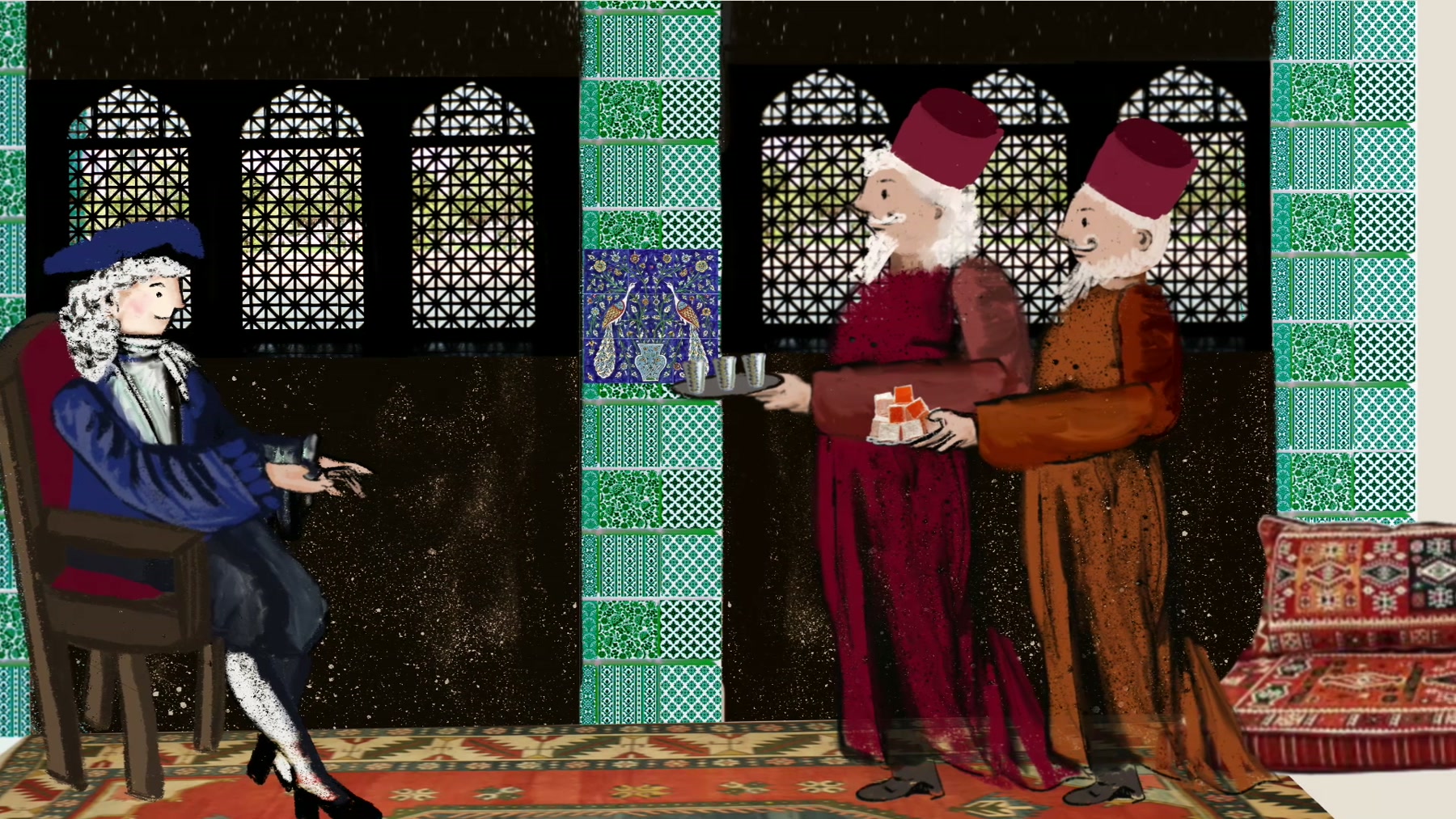
The film’s title scene: a European in a periwig seated opposite his Ottoman host, both holding the same cup. Everything the exhibition is about is in the fact that neither of them invented it.
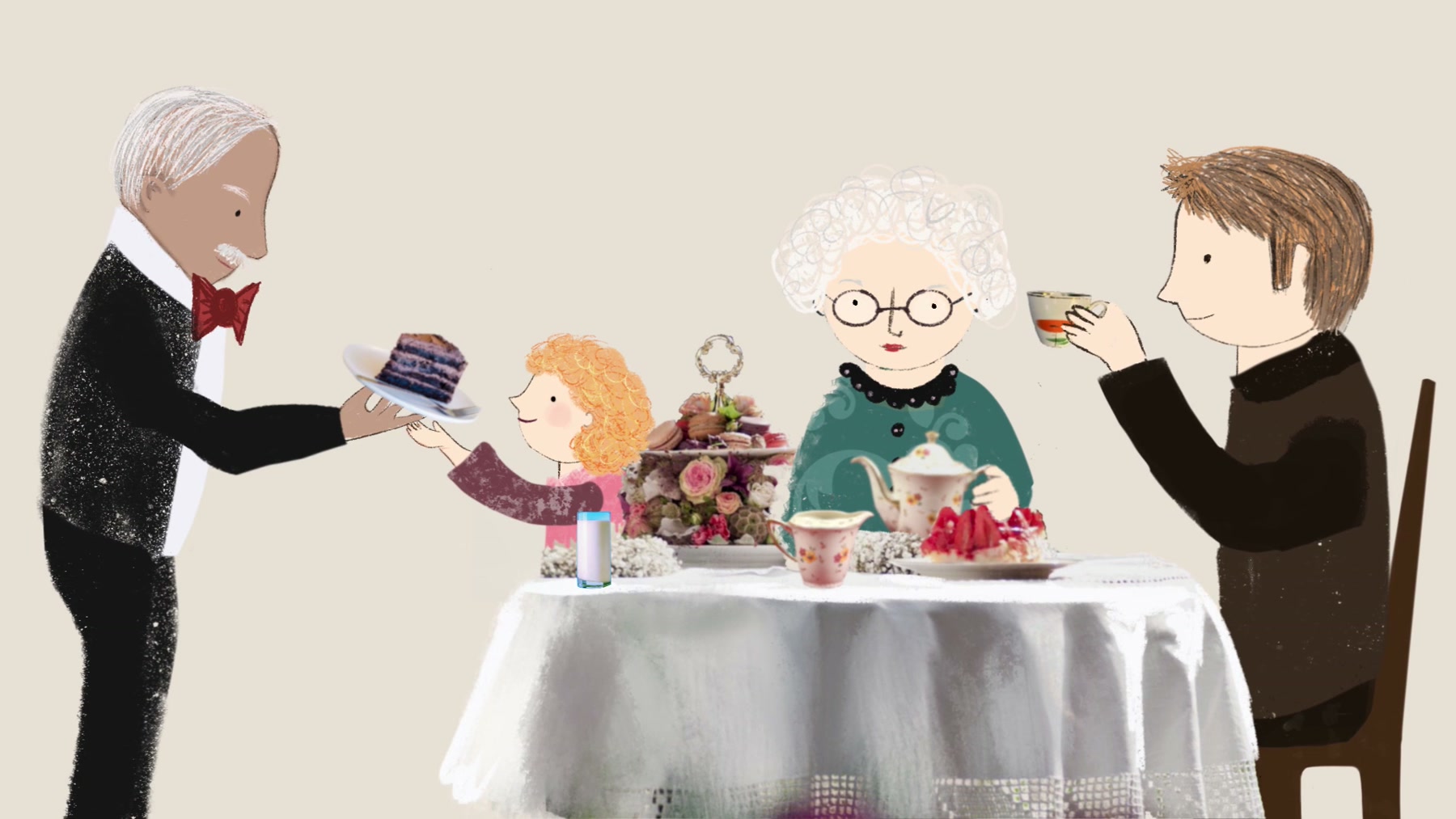
Alongside the Arab coffee culture already here, the European café arrives — the pastry trolley, the white cloth, the waiter. The red-haired girl reaching for the cake is there for a reason: she comes from a small story the exhibition’s curator, Yahel Shefer, told us about herself. The scene keeps it.
Before the exhibition opened we were given access to the collection itself — the objects still in storage, some still in their packing, on the museum’s shelves — and we chose from it ourselves. That is why the objects in the film are particular rather than generic: the pot on the table is a specific pot, the canisters being painted are a specific set, the machine behind the counter was made in Milan.
The other object the film builds a scene around is a mid-century coffee service: white porcelain with black handles, painted with a grid of black lines and blocks of red, yellow and teal. It belongs to the same European modernist current that ran through Lapid’s artistic department — geometric, abstract, and unmistakably after Mondrian.
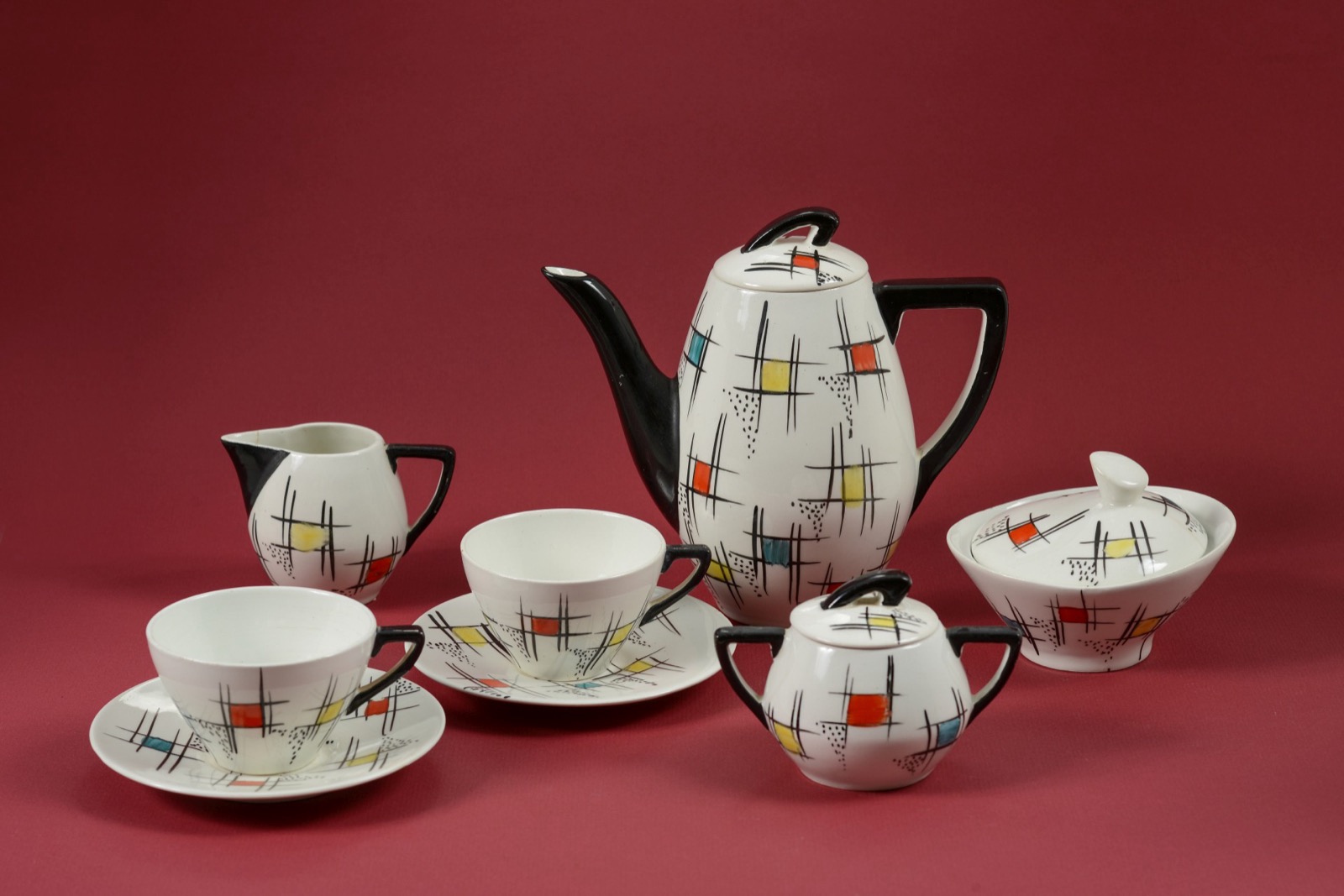
Pot, cups, saucers, creamer and sugar bowl, each carrying the same grid at a different scale.
The set on the table is that object, drawn as it is. Its decoration is then enlarged into the three panels on the wall — red, yellow and teal, the same three — so the room the film ends in is built out of the pattern on the pot. It is the clearest case of the method: we did not illustrate a period, we drew a specific thing and let it furnish the scene.
Lapid Ceramics was founded in Jaffa in 1943 and closed in 1990. It began by making roof tiles and sanitary ware, and in 1950, after the industrialist Dr. Kurt Mosberg acquired it, an artistic department was formed. The ceramic artist Elisabeth Cohen — trained under Hedwig Grossman — joined as a designer in 1952, alongside Dr. Bertha Rosenthal, who had run a ceramics works in Czechoslovakia before emigrating. Their department produced modernist tableware carrying geometric and abstract decoration, and by 1959 it employed twenty people.
The decoration was applied by hand, and the hands were almost entirely women’s. The department’s painters were tsayarot — women painters — with two men among them, working series that reached very nearly every household in the country. Pieces were signed by whoever painted them. Israel has no working ceramics factory today, and the ware is collected by pattern: the deer, the blue arabesques, the series of the seventies and eighties.
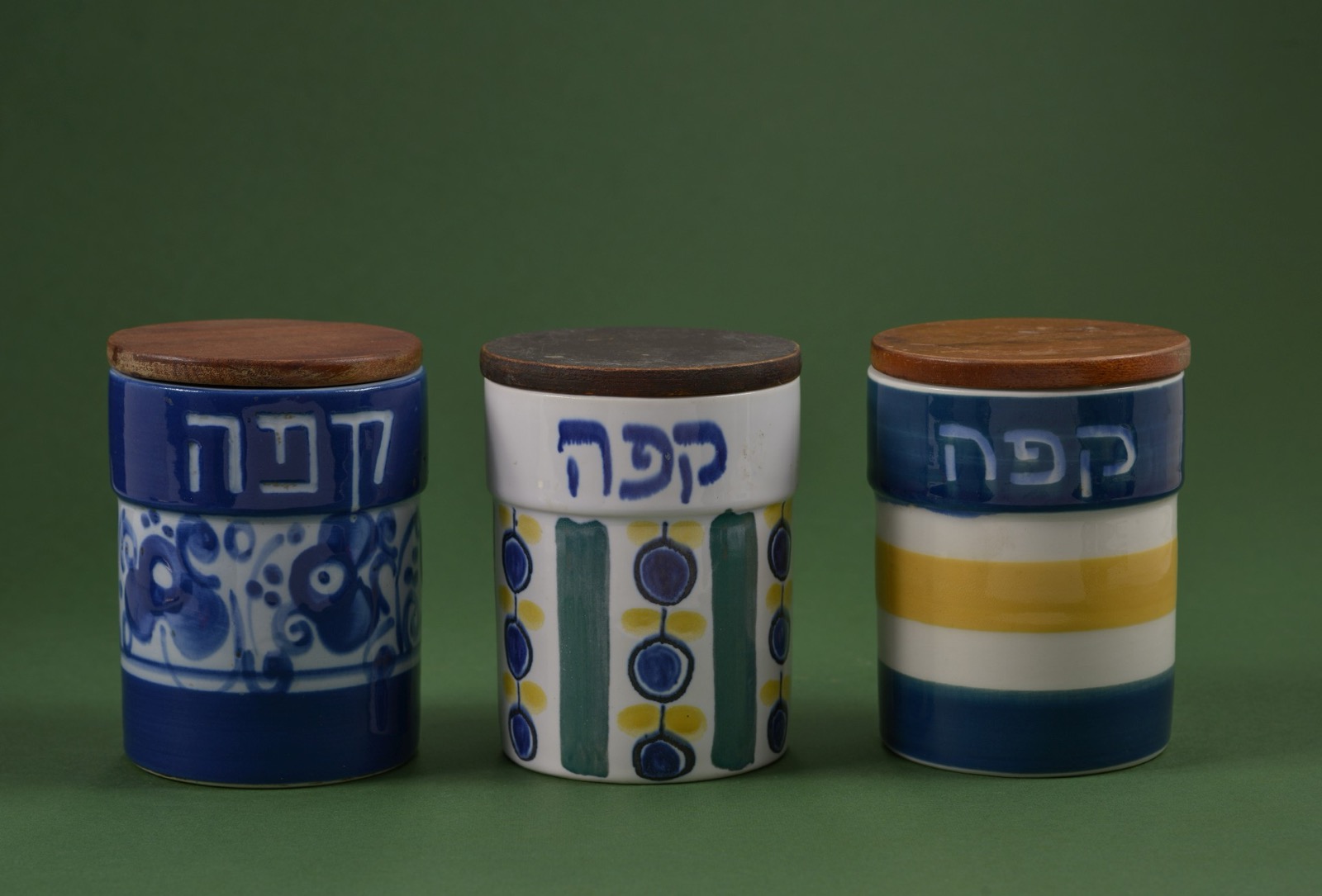
Blue florals, dots, and bands of blue, white and yellow. The Hebrew word for coffee is painted on each one. These are the objects the exhibition put in a case, and the objects a great many people in this country grew up with on a shelf.
So the film shows the painting rather than the painted object. A woman at a bench, a fine brush, the blue going onto the glaze while the finished pieces wait at her elbow. It is the one thing a vitrine cannot hold: that the pattern on a mass-produced object was put there by a particular woman, one canister at a time, and signed.
In September 1938 Achille Gaggia filed a patent in Milan for a coffee machine that forced hot water through the grounds under pressure rather than steam. What came out carried a soft tan foam nobody had seen before. A second patent in 1947 replaced the screw with a spring-loaded lever piston, and the company was founded in Milan in 1948. That machine is the reason an espresso today arrives under crema.
The claim was lettered across the front of the machines themselves: crema caffè naturale — funziona senza vapore. Natural coffee crema; works without steam. It is an advertisement, a patent claim and a description of the mechanism, all in six words on the body of the object.
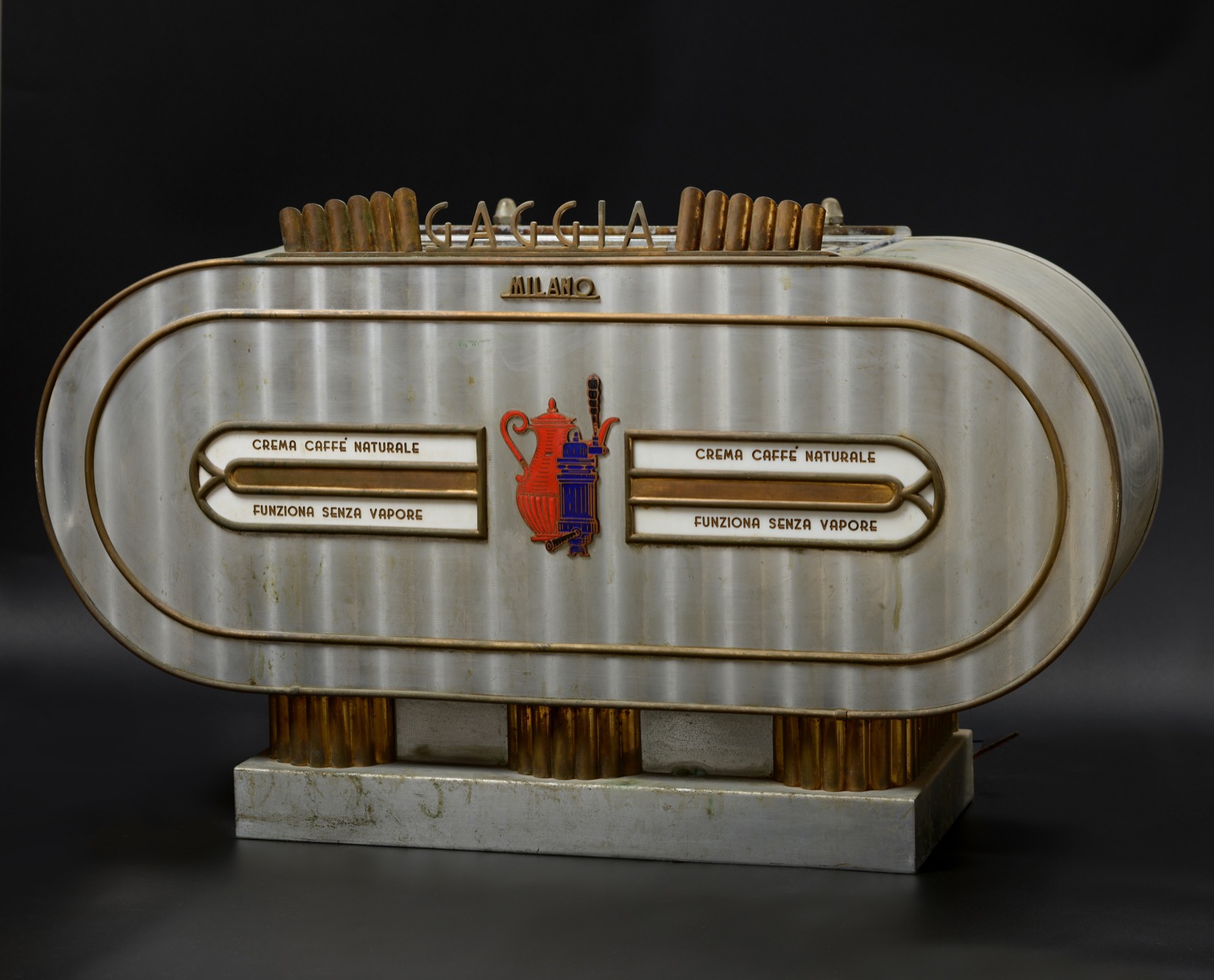
Ribbed chrome and brass, the slogan lettered on the front either side of a painted coffee pot. The exhibition borrowed heavily from Turkish and Italian collections; this is the object at the far end of the journey the film traces.
The machine enters the film the way it entered life here: not as a display piece but as the thing on the counter, with somebody standing at it. Nothing in the shot explains what it is. It does not need to — by this point in the film the audience has watched the roaster, the grinder and the pot, and this is simply what they became.