Dan David Foundation · 2026 · Prize ceremony & online publication

On Roland Betancourt, and the hand that keeps disappearing.

In 944 four men examined a cloth and could not agree what was on it. A film about what “made not by human hands” has meant since — from a Byzantine relic to a factory belt to a prompt field.

The subject

In 944 an imperial official named Theophanes rode from Constantinople to the Sagaros River to collect a mysterious object: the Mandylion, a textile said to carry an image that had appeared on it without being painted. Back in the capital the Emperor, his two sons and his co-emperor examined it. The sons saw almost nothing — the vague outline of a face. The co-emperor saw eyes and ears.

Betancourt uses that disagreement to open a much longer history: what people mean when they say an image was made “not by human hands”. It sounds medieval and remote. It is not. By the early twentieth century, factories were advertising bread and pistons as untouched by human hands, and the phrase had become a promise rather than a miracle. And it is with us again now, in the way we talk about images produced by systems we cannot see into.

The vanishing hand

The film is built on one repeating gesture. In each era a hand reaches in to make something — and then fades out of the frame while the work continues without it. The painter’s hand gilding the panel. The emperor’s son’s hand above the cloth. The baker’s hands mid-knead. The factory worker’s gloved hand at the belt. The designer’s hand at the prompt field. Four vanishings across a thousand years, and then, at the very end, one hand that stays.

Everything is painted as Byzantine icon — oxblood and lapis on cracked gold leaf — including the twentieth-century factory and the laptop. The claim is not that these things resemble each other. It is that they are the same claim, made again.

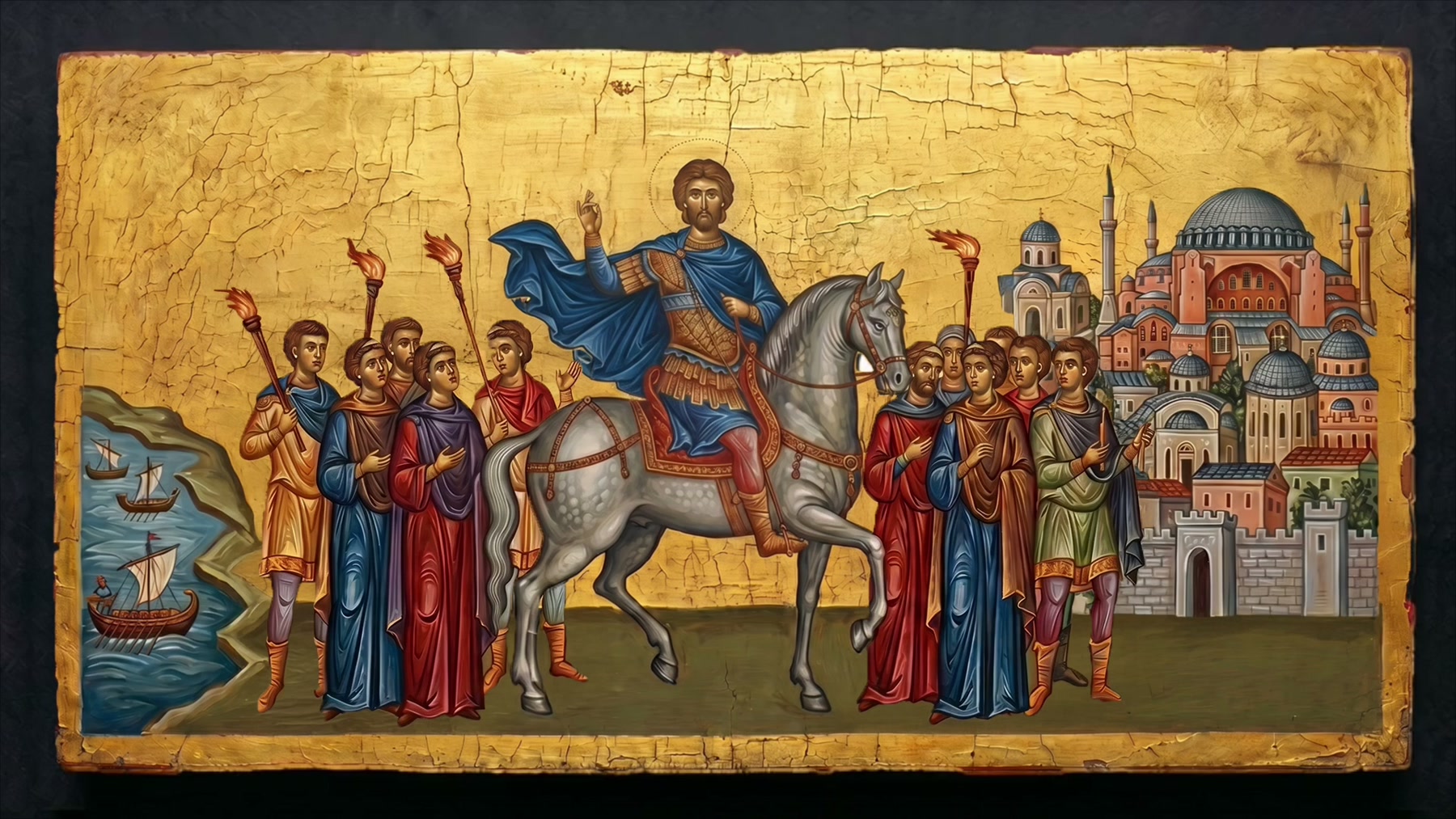
Film still: a Byzantine gold-ground icon panel showing an official on horseback with torch-bearers, the domes of Constantinople behind
944

It begins as an icon painting itself.

Theophanes rides out from Constantinople with his torch-bearers and chanters, the river ahead of him and the domes behind. The whole film happens on panels like this one, which is the argument: we are being shown a history of images in the language of images.

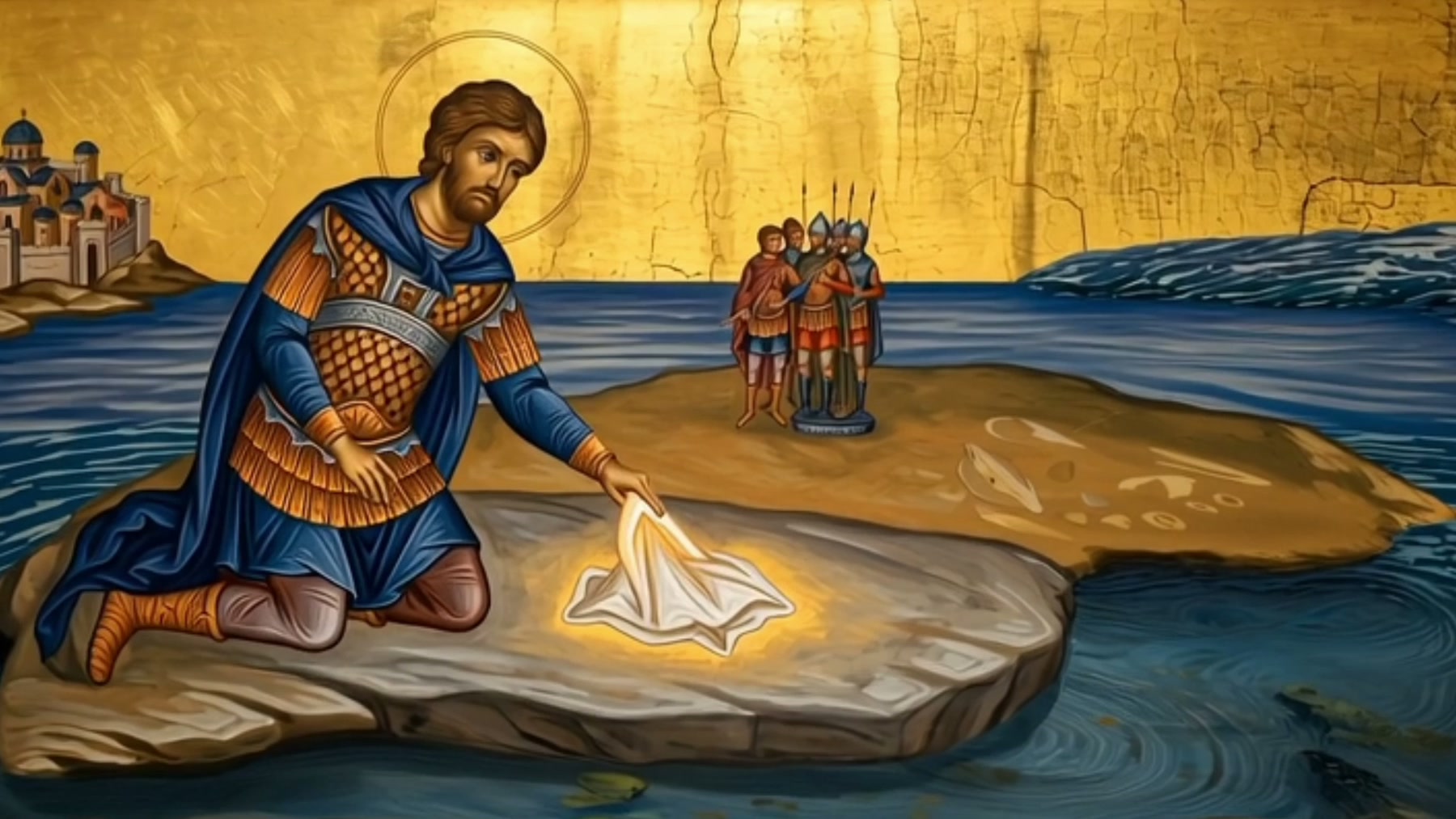
Film still: painted hands passing a folded white linen cloth, rendered in flat Byzantine fold-convention on gold ground
The object

A depiction of a thing that was said to need no depicting.

The cloth is handed over, painted in the flat geometric fold-convention of the icon — and where the audience expects a face there is only the faintest ghost of one. An icon of an icon, deliberately almost empty.

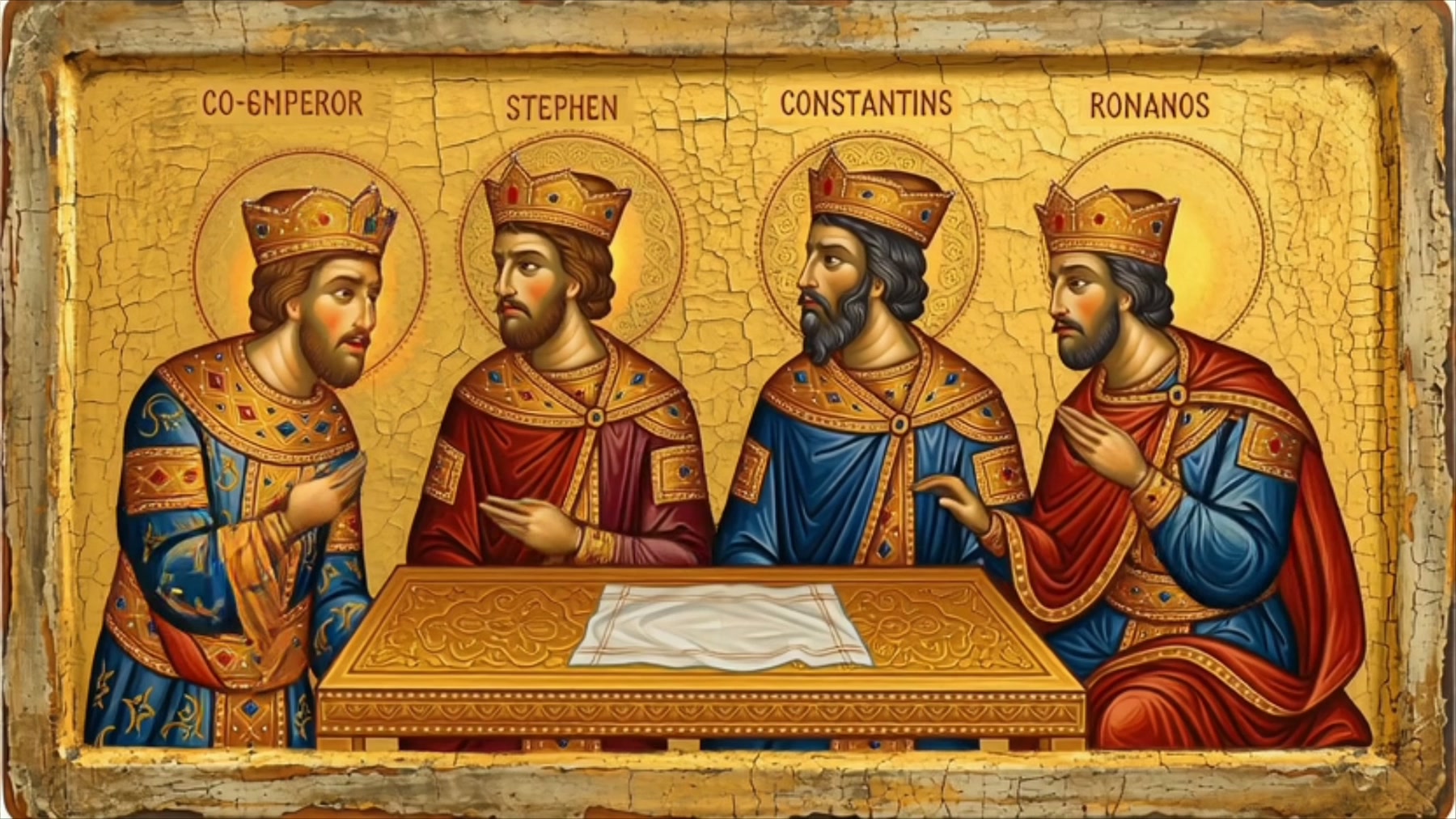
Film still: four crowned Byzantine figures behind a gold table with a white cloth laid before them
The disagreement

Four men, one cloth, and no agreement about what is on it.

The Emperor, his two sons and the co-emperor examine the textile together. Three of them lean back; one leans in, lit from within. The sons see nothing but an outline. The co-emperor sees eyes and ears. The film lets the features ghost in for a single beat — then lets them dissolve.

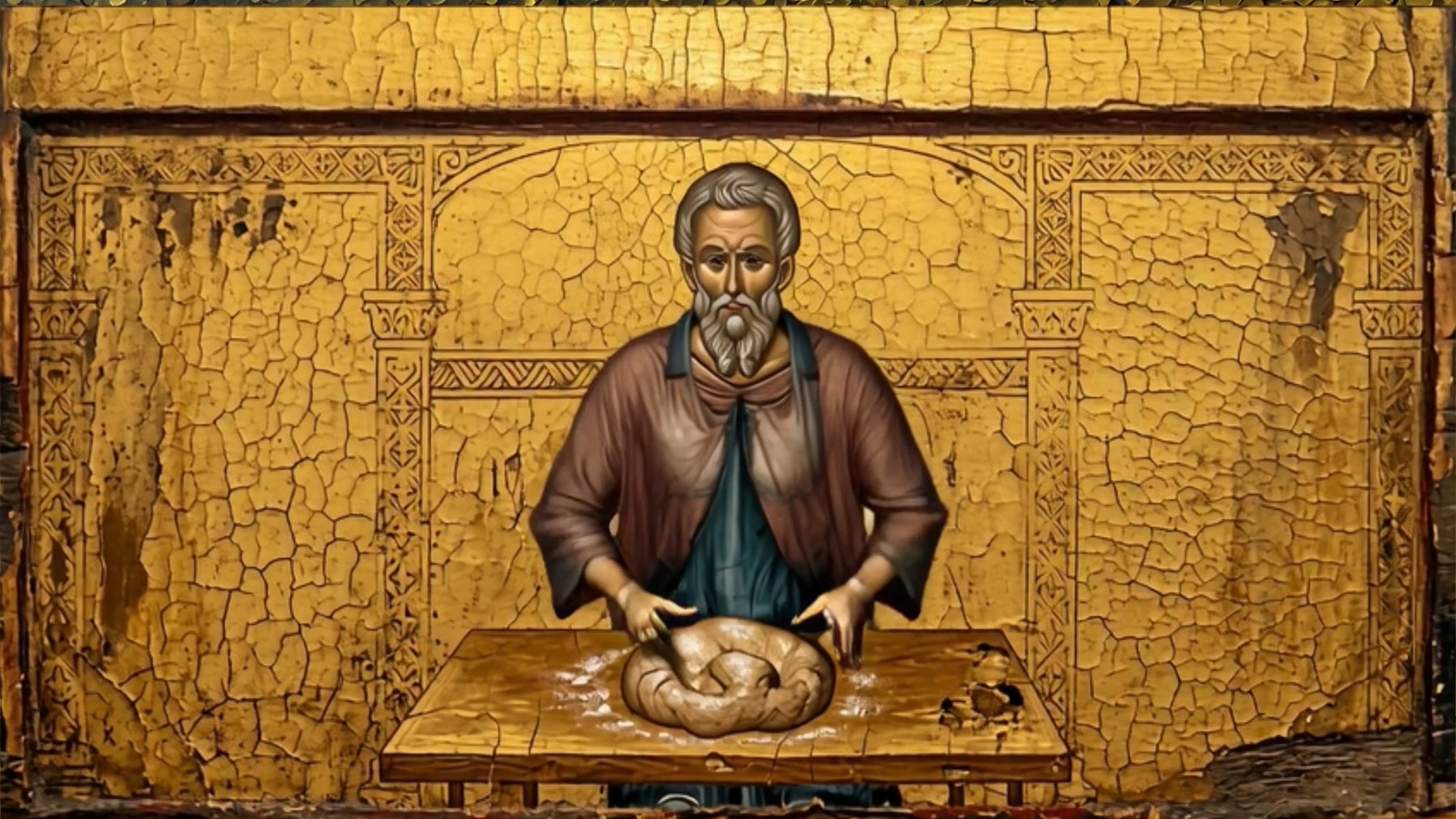
Film still: a Byzantine-style baker in oxblood and lapis working a round loaf on a gold table
Not by human hands

And then the same phrase turns up in a bakery.

A baker shapes a loaf the way a baker shapes a loaf every morning. Then his hands fade mid-gesture and the bread goes on transforming by itself — flattening, squaring, hardening into a mid-century sliced loaf in wax paper. Above it the words soften from not by human hands to untouched by human hands.

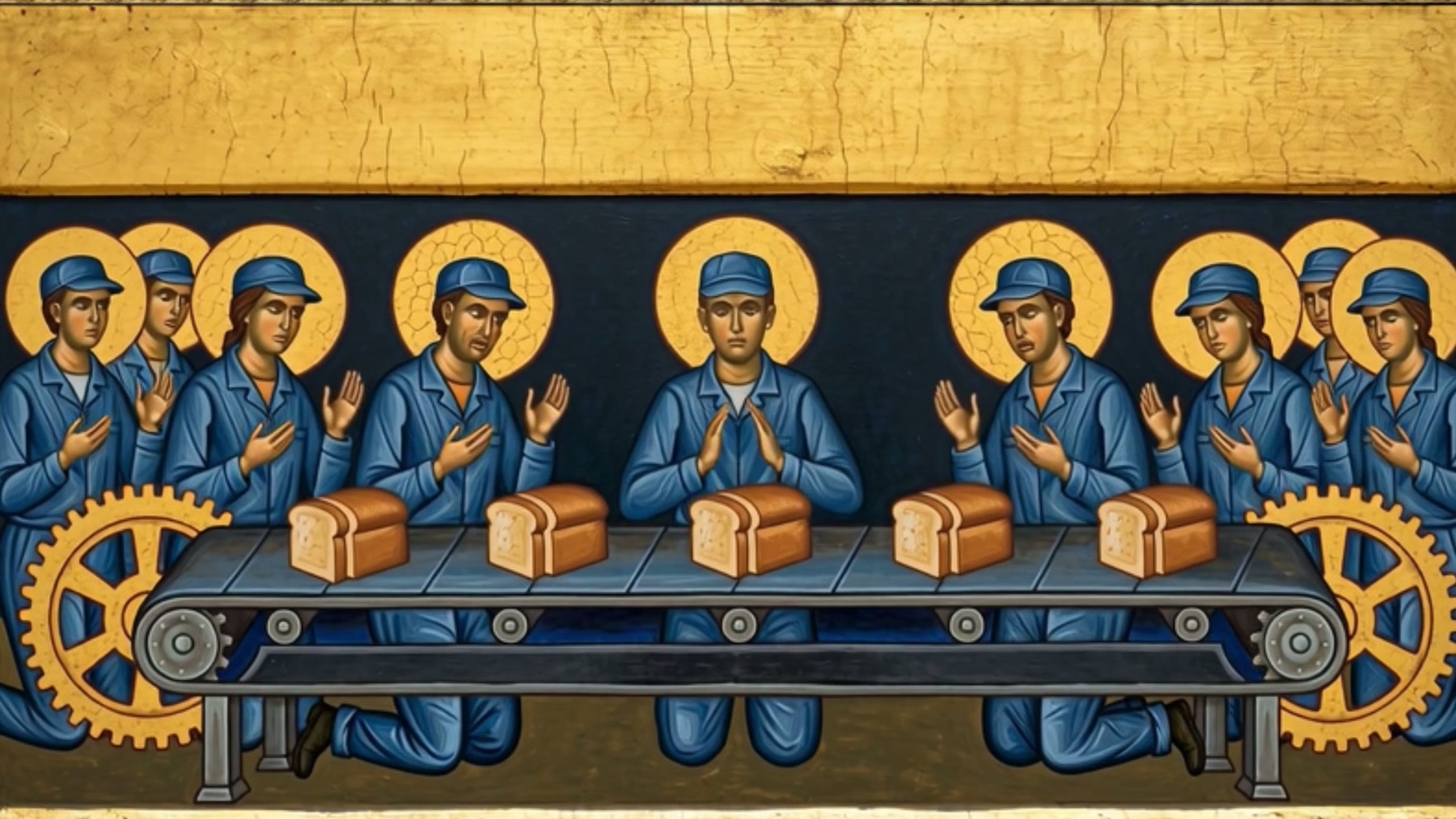
Film still: sliced loaves moving along a conveyor belt with gold cogwheels, workers kneeling either side with cracked gold haloes
The factory

Workers kneeling beside the belt, with haloes.

Five identical loaves travel as offerings. The workers are in blue coveralls with cracked gold leaf behind their heads, hands raised in the orans position. A gloved hand reaches for an incoming loaf and fades before it touches. The belt does not pause.

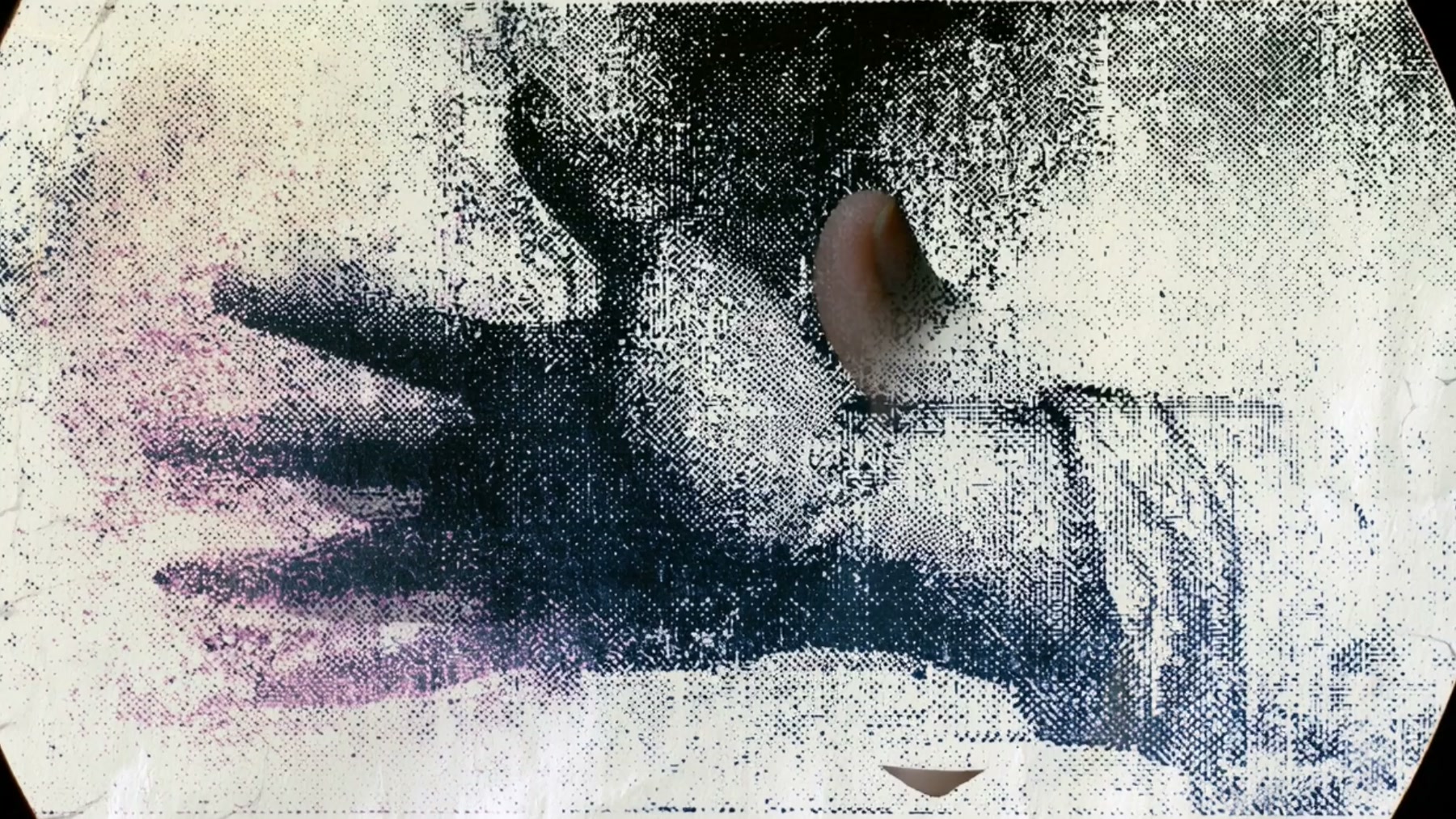
Film still: a Byzantine icon of a hand degrading into halftone noise and pixels across successive copies
The copy of the copy

Five generations, and the image forgets itself.

The panel becomes an icon of a single open hand. A photocopier lid comes down — the hand closing it fades — and the image is copied, and copied again, until it dissolves into halftone noise and then into chunky pixels. That is the seam where the analogue becomes the digital, played as a stop-motion.

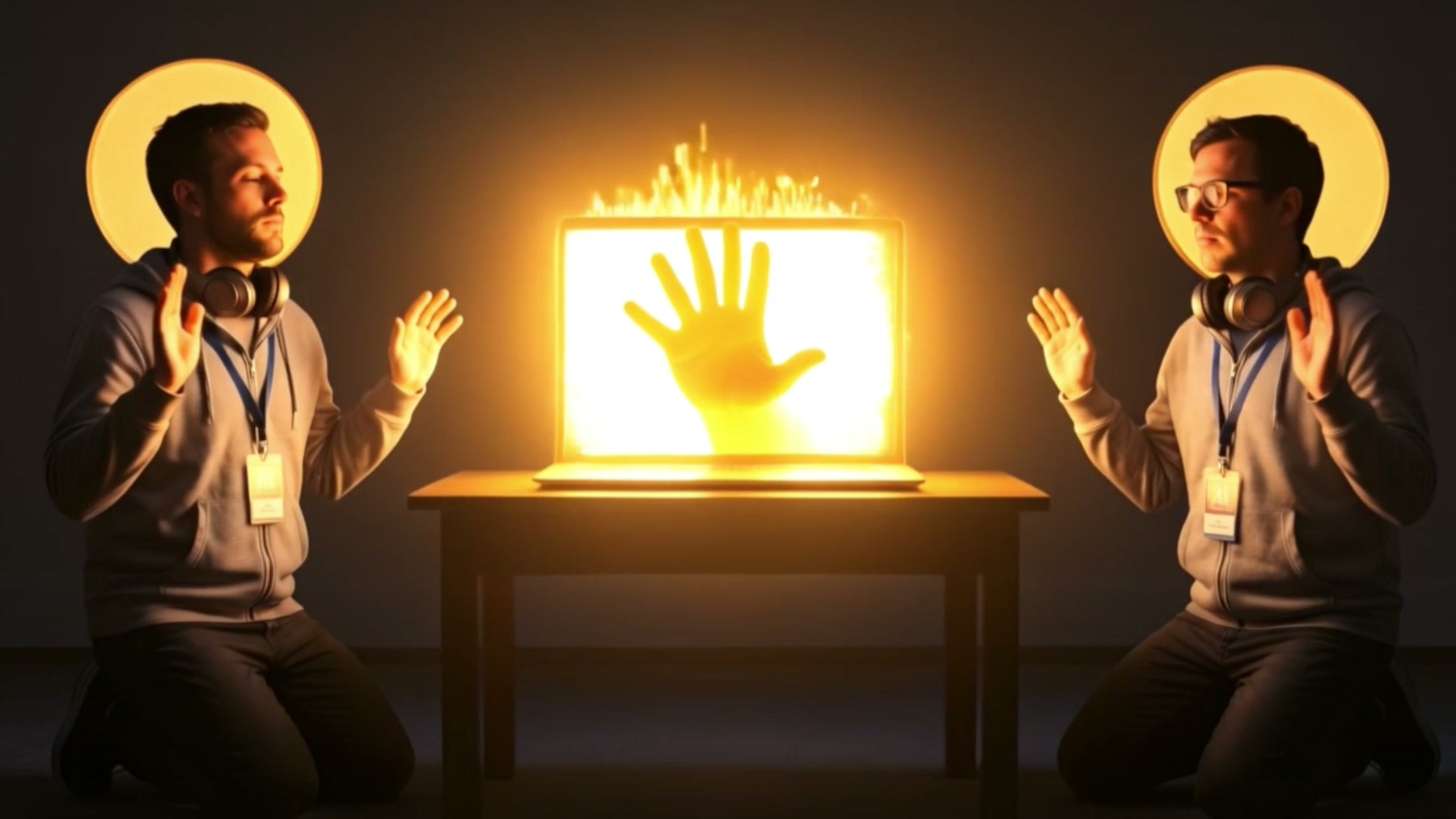
Film still: two haloed figures in hoodies kneeling either side of a laptop on a table, hands raised, gold particles falling
Now

The laptop is the altar and the screen is the icon.

Two workers in hoodies and lanyards kneel on either side of a laptop, haloed, hands raised in the same orans position as the factory workers. On the screen is a hyperreal Byzantine icon of a hand, suspiciously perfect. It has six fingers. Nobody notices. A stylus reaches toward the prompt field and fades, and the cursor keeps typing on its own.

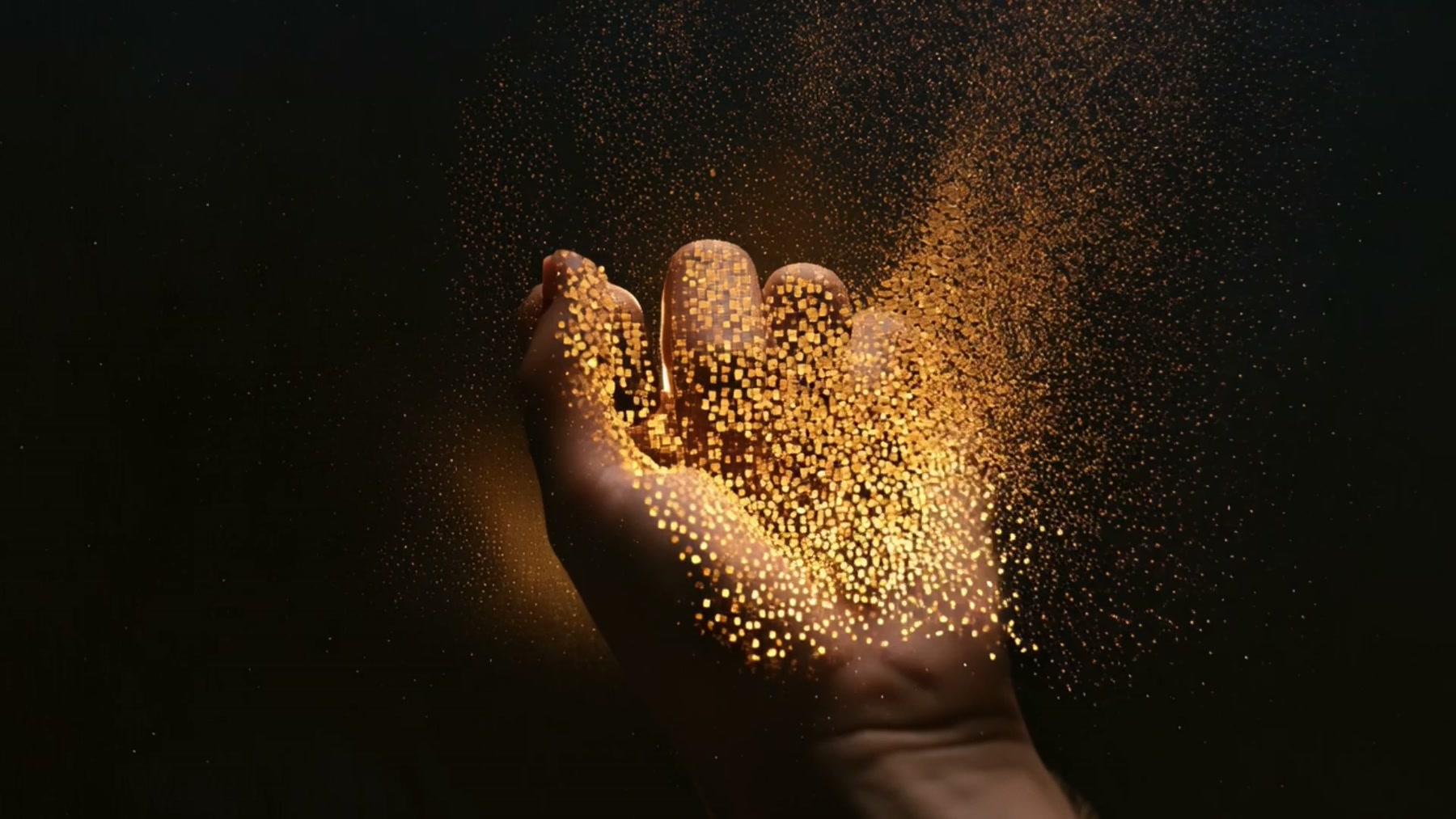
Film still: a cloud of glowing gold pixels reorganising into the shape of a human hand
The gold travels

The same gold, all the way through.

The generated image breaks into gold pixels, and the pixels reorganise in place — into a sliced industrial loaf made entirely of gold, then into the silhouette of a hand, and then into a real one, the gold settling into skin like freckles. Then the film cuts to that hand at a photocopier, laying an icon face-down on the glass. It presses copy, lifts the sheet, lays the panel back down and presses copy again. This time the hand does not vanish.

About the laureate

Roland Betancourt is a historian of Byzantine art and its afterlives in contemporary culture. The Dan David Prize selection committee described him as “a highly creative cultural thinker whose expansive research offers unique perspectives on the Byzantine empire as much as on Disney parks and the modern world, and whose work has reshaped the discipline of art history.”

How the film is made

Each year the Foundation selects its winners and, with the help of the laureate, chooses the subject of the film they are being honored for. The Foundation’s team, who know that work intimately, help bring it to the page, and we turn it into script, image, register, and motion.

The one thing we keep from them is the film itself. It is made in their honor but held back, so that the first time Roland Betancourt meets it, in animated form, is the evening of the prize — the very moment they are being celebrated for the work it depicts. That is the part of the project we love: a film that is also a gift, a surprise, revealed in the room where it does its work.

Where the films travel

The Dan David films don’t end their life on the evening of the prize. After the ceremony they travel to YouTube and to the Foundation’s own website, where each one sits alongside the committee’s reasoning for choosing the laureate and further material on the research. The winners are interviewed once the films are public, and those interviews are woven into the published versions.

You care about your subject.
So do we.

Let’s talk →
Credits

Client: Dan David Foundation
Subject: Prof. Roland Betancourt
Direction: Daniella Koffler
Animation: Moofa Animation Team
Year: 2026

← All work     Start a conversation →